
Educating with Sibelius
Vermont MIDI Project Builds a Student Community with Sibelius Software
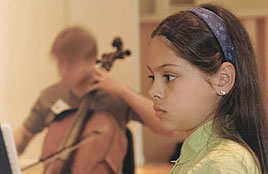 Annapurna, student and Vermont Midi Composer |
In more than 70 schools across Vermont, music educators are using the power of Sibelius and the Internet to give more than 7,000 students in grades K-12 a hands-on experience in musical distance learning that was never before possible.
Sibelius is a powerful music notation software package that makes it easy not only to compose and arrange original music on a computer, but to print it, save it to CD - and, in a vital component of the Vermont MIDI Project (www.vtmidi.org), share it over the Internet. With the free Scorch™ plug-in, Sibelius users can see each other's work on-screen and hear what it sounds like, switching easily among instrument voices, tempos and keys. In the classrooms of several public elementary schools in Vermont, these tools have unlocked a torrent of creativity and ability.
Originally funded in 1994 by the Vermont State Legislature and subsequently by funds from the federal agencies in grants to the WEB Project and the Vermont Arts Council, the Vermont MIDI Project provides schools with Musical Instrument Digital Interface (MIDI) computer workstations so that students can compose music and send it to mentors for feedback. The original distance learning grant allowed those with common interests, separated geographically, to work together to reach the standards set out by the Vermont Framework of Standards and Learning Opportunities and the National Standards for Arts Education.
The Vermont MIDI Project includes experienced-based classes in music composition, but that's only the beginning - by posting their work online, the young composers get feedback from each other and from several professional mentors. Since they use Sibelius Scorch, which provides download of compositions for viewing and playback, mentors and fellow students can both see and hear the works, enabling a full creative dialogue.
Critique is a part of the classroom culture, and all participants are required to evaluate the work of students in their own schools as well as others in a respectful, constructive atmosphere. A given composition may go through several cycles of posting, commentary and revision during its lifespan. When the compositions are done, students share the finished product over the Web for all to appreciate.
Since April 2000, the program has featured public "Opus" concerts in which student compositions are performed live by professional musicians - including members of the National Symphony Orchestra, the Vermont Symphony Orchestra and the Constitution Brass Quintet - who rehearse with each student. Opus 10, scheduled for November 2004, will showcase 18 original works by MIDI Project students from around the state.
Elementary school participants in the project have met with remarkable success in national competitions. Eva Sachsse, a fifth grader at Marion Cross School in Norwich who takes part in the program, was named the 2004 elementary division winner of the National Student Electronic Composition Talent Search - the second Vermont MIDI student to win that category in the three years the event has been held. Her submission, Song of the Sirens, emerged from a 5th grade classroom study of the Odyssey. In addition, Allie Homziak of Champlain Elementary School in Burlington was the sole elementary school composer selected to represent the eastern U.S. at the 2004 National Biennial In-Service Conference of MENC, the National Association for Music Education, in Minneapolis.
The Vermont MIDI Project turned to Sibelius in 2000 for a better way for students to create music and share it online. They chose Sibelius for its features, its use of the free Scorch plug-in, and not least of all, its ease of use.
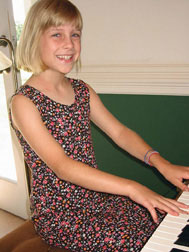 Christina Koller, student and Vermont Midi Composer |
"We have found that the elementary students have no difficulty using a professional music notation software package like Sibelius," says Vermont MIDI Project coordinator Sandi MacLeod. "Much of the time, kids are more computer savvy than many of their teachers, and they are undaunted by the wealth of possibilities that Sibelius offers them. And the use of notation software promotes music literacy for students who compose. Everyone in our project recognizes that it was a huge boost when we started using Sibelius and Scorch."
Aaron Audet, the Instrumental Music Director at Proctor Junior-Senior High School in Proctor, uses Sibelius for his music theory classes. "I think Sibelius is the best learning tool for music theory," he says. "When the students play their music back, the computer doesn't lie. They will hear a mistake, then be given the opportunity to figure it out and fix it. Sibelius allows the students to write and be creative; as we've read in many articles, writing comes in more than a language form."
Music teacher Ellen Bosworth at Richmond Elementary School, finds that Sibelius helps younger kids take part in the MIDI Project as well. "Sibelius opens up a new exciting way for children to experience composing for different instruments and sounds," she reports, "and it allows teaching composition in a way that enables kids in the younger grades to be much more creative and experience more 'real' music than they otherwise would be able to do with hand-written or self-performed compositions. Teaching basic harmony and theory is now a reality!"
"I can teach more effectively to the composition standards, help kids remain excited about music and composing, and further instill a deeper understanding of music that at the elementary grade level would not be achieved," Bosworth adds.
Christina Koller is a seventh grader who participates in the Vermont MIDI Project at the Bridport Central School in Bridport. She began using Sibelius in the third grade.
"I love that Sibelius gives me the ability to change the background and lets me quickly write down the things I have in my head," she says. "It lets you hear things and see if you like them or not. It's extremely easy to use."
Her mother, Sharon, appreciates the effect Sibelius and the MIDI project have had on her daughter.
Other case studies

SibeliusEducation forums
Chat about teaching and learning in Music.