
Educating with Sibelius
Hills Road Sixth Form College
Jonathan Sanders, Director of Music, reveals how Sibelius has helped improve results year-on-year and is now used for both coursework and exams.
"I already had some concept of what Sibelius was about when I started at Hills Road eight years ago," recalls Jonathan Sanders, "and, although there were no computer facilities in music, I could see the potential for the use of IT in the classroom and was keen to encourage it.
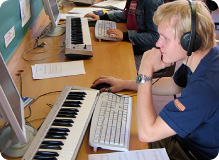 Initially, we just set up a small number of computers in a separate room for those music students who had chosen the composition option at A-level. However, when Curriculum 2000 made composition compulsory for Music AS, those students coming to Hills Road who didn't really view themselves as composers found themselves having to compose nonetheless, and I feel very strongly that Sibelius has been particularly beneficial for them. Many students find it very difficult to imagine how a score sounds just by looking at it (as do I!), and the immediate facility to hear the music they are writing in Sibelius enables them to compose far more successfully than would be possible otherwise.
"Five years ago a small number of students would produce hand-written compositions. Now nobody does, partly because our understanding of Edexcel's criteria is that, as long as you use the software appropriately (putting in articulation, phrasing, dynamics, and so forth), then you're going to come out with a better mark if you use Sibelius than if you don't.
Auralia
 Auralia and Sibelius have both had a big impact on Jonathan's teaching for the Edexcel written exams too. "We've been using multiple copies of Auralia for several years now to prepare our students for the A-level listening questions. What's particularly good about this is that Auralia has a massive ability range, so that students can work individually at their own pace, and are able to target particular areas of weakness for themselves. But at the same time, it means that everyone can still be in the same room so that I can monitor progress.
"As an examiner for AS Music, I know how important it is for the students to put enough detailed performance directions in their scores. I've found Sibelius to be good for doing this, especially now that I know a few keyboard shortcuts, such as using the space bar to spread a slur over successive notes. Things like that make life so much easier! You can populate a bare score with performance markings far quicker using the keyboard than the mouse. The whole Filter system has also proved very useful for our Music Technology students, who can very quickly tidy up scores created using MIDI files exported from Steinberg Cubase SX 2."
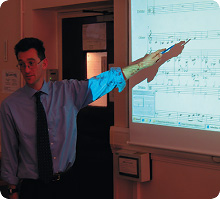 "Sibelius has been very successful for harmony work, both for the chorale and serialism questions. We teach a very traditional four-part chorale approach here, and we used to say that competent keyboard skills were required so that students would be able to play chorales through on the piano. However, now that you can play back at any speed in Sibelius, we've been able to downgrade that expectation.
"For serialism work the Matrix Generator is very useful, because it can do all the retrogrades and inversions for you. I have said to Edexcel very clearly that if you have Sibelius 4 with the Matrix Generator, you are going to be in a much better position in the A2 Harmony exam than if you don't, but the exam board have been unable to police that at all!
"In the Music A2 Harmony exam a few years ago, a limited number of people would opt for a stand-alone keyboard with headphones over Sibelius, but this year everyone's using Sibelius and printing out their answer sheets. It seems now that there is an impression amongst the students that, even in a time-pressured exam situation, Sibelius is a better option than writing stuff out by hand.
"For the less able students, I think Sibelius improves the exam outcome. Our exam performance has continued to improve year on year, in particular because the D- and E-grade students are now getting Cs – this could be for many reasons, but I think Sibelius has got to be an element of it."
Jonathan Sanders came to teaching after a some years in the music industry working with the London Symphony Orchestra and as a music agent. He is now Director of Music at Cambridge's Hills Road Sixth Form College, which was recently awarded 'designated outstanding' status by Ofsted. Of the 1780 full-time A-level pupils, 80 study Music and 50 Music Technology, all of whom use Sibelius via the department's 50 computer workstations. A vibrant programme of extra-curricular music activities includes an 80-piece symphony orchestra; a chamber orchestra; a wind orchestra; college, chamber, and jazz choirs; a brass ensemble; and a jazz/funk band. Four smaller chamber ensembles are also supported through an instrumental awards scheme.
“ You’re going to come
out with a better mark
if you use Sibelius than
if you don’t.”
Jonathan Sanders, Director of
Music at Hills Road College
- Hills Road Sixth Form College was recently awarded ‘designated outstanding’ status by Ofsted.
- There are 1780 full-time students.
- 80 study Music and 50 Music Technology, all of whom use Sibelius via the department’s 50 computer workstations.
- A vibrant programme of extra-curricular music activities includes an 80-piece symphony orchestra; a chamber orchestra; a wind orchestra; college, chamber, and jazz choirs; a brass ensemble; and a jazz/funk band.
Other case studies

SibeliusEducation forums
Chat about teaching and learning in Music.