Education Case Study
St Marylebone School
Director of Music Matthew Glenn explains how Sibelius helps engage students with music from Key Stage 3 music right through to A-level Music Technology.
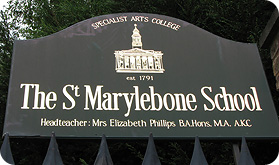 Sitting at the intersection of Marylebone High Street and Marylebone Road in central London, St Marylebone Church of England School is a voluntary aided, multi-faith comprehensive school for girls aged from eleven to eighteen.
A walk down Marylebone High Street with its thriving, upmarket shops and restaurants speaks of a very prosperous community; but a 38% eligibility for free school meals (well above the national average) suggests a somewhat different story.
Founded in 1791, St Marylebone prides itself on offering, “a haven of peace and tranquillity where traditional values underpin a modern forward thinking outlook.” The 858 students have the benefit of attending a school that has been awarded Specialist Status in Performing Arts (Music, Drama and Dance) and Maths and Computing.
Peace and tranquillity, however, is a distant dream for the Music Department which is presently undergoing dramatic reconstruction.
“We were,” says Matthew Glenn, Director of Music, “supposed to be in the new building last September but it has taken a lot longer than first thought.”
The building reorganisation has been accompanied by a change of software platform, from Windows to Mac. By September 2007, 40 Apple Macs will have replaced the 30 PC workstations and Logic will have supplanted Cubase as the sequencing software of choice.
The one constant in this necessary upheaval is Sibelius. The music software’s eponymous score writing and notating program has survived the transition from old to new and has been upgraded this year. The music department, says Matthew, never considered any other option.
“We’ve always believed that this was the best notation software and the most suitable for educational use.”
It would be no exaggeration to say that Sibelius is at the core of music teaching at St. Marylebone and underpins music lessons from Key Stage 3 through to A and AS level.
The Music Department, made up of four full time members of staff, three part time and more than twenty peripatetics, presently organise instrumental lessons for more than 300 students and have 30 music students in year ten and 34 in year 11. In the sixth form there are six students studying Music at AS Level and seven at A2 and ten students taking Music Technology at AS and four at A2. The department also runs a concert orchestra, senior orchestra, a wind band, jazz band choirs and other small ensembles, all of whom use arrangements generated by Sibelius
At Key Stage 3, Sibelius is used for all the performance work. On alternating half terms the students are assessed on performance and composition with the work being stepped in levels of difficulty. All the scores are printed out using Sibelius so,
“If we’re doing, say, the Blues,” says Matthew, “there are five different versions which the kids can use.” There’s also a Polyrhythmic assessment, a Classical one and a Music and Drama one and the students are required to play these scores in real time. They can, of course, Matthew adds, “Go into that resource and the software will play it for them so they can hear it for themselves.”
Students at KS4 are required to produce two compositions and these have to be notated. One of the most popular subjects is Serialism, the rigorous, some would say forbidding, domain of Schoenberg, Berg and Webern, which, Matthew admits, came as something of a surprise.
“It’s based on a tone row and it’s quite formulaic – you have to retrograde it, invert it, verticalise it and do all these funny things to it. But once the students have done that they can be quite creative and wacky as to where precisely they put the notes on the stave.”
Music technology is used throughout the curriculum and the department is, as far as possible, paperless. Students save their work to user areas which can then be accessed and appraised by the teaching staff. Technology, explains Matthew, “is used ‘idiomatically’. For example, arrangements for classroom performance are projected onto a Smartboard so that students can follow the music together and use the whiteboard pens to annotate the score.”
“They’re a digital generation; they know what’s what and they’re very quick”
Teaching time is at a premium at GCSE level with students being allocated three music lessons per week. Little of this time is spent on learning how to actually use Sibelius – Matthew reckons one or two lessons – which is testimony to both the students’ technophilia and the transparency and ease of use of the software.
Sibelius Student
Students use the music rooms at lunchtime and in the evening. There’s also a growing trend, Matthew reports, for them to buy Sibelius Student, the ‘lite’ version of Sibelius, and transfer files to each other or post to the Sibelius website using Sibelius Scorch technology.
Unfortunately, the ongoing reorganisation at St. Marylebone has severely limited the use of Sibelius but Matthew looks forward to using two of the program’s most powerful new features. Dynamic Parts allows users to instantly update all parts whenever a full score is revised. No more extracting individual parts and cleaning them up when a score is altered.
Sibelius also makes it far easier to synchronise video to a film score, something that will make life significantly simpler for Matthew and his colleagues. “In terms of Key Stage 3 we want to do more with film music. When we do film music at A level I’m sure that this new feature will prove to be useful.”
“It makes notating music so easy. Music comes to life with Sibelius”
That’s the view of Annie, one of St. Marylebone’s sixth form music students. Simon Conway, the teacher in charge of Music Technology concurs.
“Sibelius is a valuable tool for both teachers and students. It is easy to produce high quality and clear worksheets and is particularly vital for A level Music and Music Technology students when they are required to produce professional scores of their compositions.”
At AS level, there’s a whole composition section, explains Matthew, and if the students go on to do it as a specialist option at A2, they have to use Sibelius, because they’re assessed on their score so it’s got to be perfect. Generally, Sibelius has had a, “massive impact on coursework,” and worksheet preparation. Matthew, for instance, teaches the Bach Chorales in harmony for A level and finds it very useful, “to do that using Sibelius because it’s so clear. And it’s quick.”
Matthew, who is also a Music Consultant for Westminster LEA, is adamant that ICT should be used as a tool, not as an end in itself.
“Kids have got to experience music live and they’ve got to make music themselves.”
One surprising aspect of technology, he laughingly recounts, is that it can give students an unfair expectation of human performing ability.
“At AS level, we’ll play the compositions live and often Sibelius can play things that real people can’t. Sometimes it’s a shock for the students. They’ll say, ‘Well, it plays it in Sibelius’ And we might point out that, ‘Yes, it’s a computer. It can probably play anything. We can’t!’”
On a more serious note, however, Sibelius software undoubtedly gives students expectations that are real, achievable and inspiring. Sibelius is, Matthew believes, quite indispensable.
“In terms of our curriculum,” he asserts, “it’s crucial.”
“Music comes to life with Sibelius. It makes notating music so easy.”
Annie, student at St Marylebone
Other case studies

SibeliusEducation forums
Chat about teaching and learning in Music.