Educating with Sibelius
Sibelius Software Brings New Possibilities to Colorado Suzuki Institute
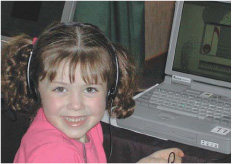 Rebekah, 6 yr. old violin student from Grand Forks, North Dakota practices with the Musition program |
The Colorado Suzuki Institute, which meets yearly in June in Snowmass, provides students, parents and teachers the opportunity to study the philosophy and music teaching approach of Dr. Shinichi Suzuki and the principles of Talent Education as a supplement to year-round lessons. For years, Director Gail Seay had envisioned a more technologically advanced approach at the Institute — and this year, her vision became a reality with software from Sibelius USA.
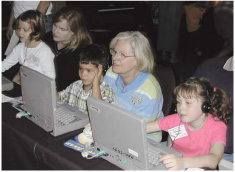
Sibelius USA provided the Institute with a 20-seat site license for the music education application of Sibelius 3 notation software and site licenses for Musition, Auralia, Starclass, Compass and Instruments— all part of the Sibelius Educational Suite. Seay reports that it helped the 970 students in the program to stay challenged and progress at an individual pace, and the program’s teachers felt it made them more effective, too.
“Since we converted our musicianship classes to computer labs using Sibelius software, students at the Colorado Suzuki Institute enjoy learning theory and composition because they can learn at the pace that is appropriate for them,” explains Seay. “If they need more repetition in an area, they can do so without feeling embarrassed. If they grasp a concept quickly and want to move on to another level of learning, this software makes that possible.”
More than 40 years ago, Dr. Suzuki, a Japanese violinist, realized the implications of how easily children learn to speak their native language. He began to apply the basic principles of language acquisition to the learning of music, calling his method the mother-tongue approach. His ideas of parent involvement, loving encouragement and constant repetition are at the core of what is now known as the Suzuki Method.
Seay’s involvement with the Suzuki Method began in 1982, when she attended a business meeting where the entertainment for the evening was a Suzuki violin group. “I was struck by how much the children enjoyed performing, something that I did not see among students who learned music by the traditional method,” she says. “Soon thereafter, I attended a workshop to learn more about the Suzuki Method and receive training myself to teach using this method, and have been using it exclusively for the last 22 years.”
After the institute’s 2003 program, Seay made the decision to have musicianship classes taught in computer labs so that students could self-pace their learning. She sought the advice of a noted Suzuki theory and composition teacher, Dr. Carl van Wyk of Dallas, regarding the appropriate software for her students in Colorado.
Dr. van Wyk says he recommended Sibelius because it could do everything Seay wanted for the broad range of ages and theory levels of the students at the institute. “First of all, the Sibelius notation program is superb,” he explains, “and then they’ve got these super products, Musition and Auralia that we’d use for presentation of the theory.”
 |
Because the Suzuki Method is so well-established, Dr. van Wyk was asked what steps he and his colleagues had to take in order to integrate the Sibelius technology into the program. What they found, he says, is that the software actually complemented the program’s existing strengths. “Suzuki kids are doers,” he explains. “They have terrific facility, but they don’t necessarily have a theoretical background. But when you explain what it is, they really adapt to it. The kids were delighted, the teachers were delighted, and they all wanted to do it more.”
In cooperation with Dr. van Wyk, the Institute’s faculty designed two classes for this year’s summer session specifically to take advantage of Sibelius applications. A musicianship class, required for all students, made use of Musition and Auralia, and Dr. van Wyk taught an elective composition class using Sibelius 3 and Instruments.
“In the musicianship class, I suggested that they start with a topic — let’s say notes or scales — then go over to a computer and do the ear training part of that topic,” he explains. “That way, there’s a tie-in between the theory and the actual sound.”
Each student was accompanied by at least one parent, and the anonymous class evaluations they wrote speak volumes about the role Sibelius played in the program. “I went into this class not happy with the idea of my son ‘playing with a computer’ instead of doing violin,” said one parent about teacher Anne Baker’s musicianship sessions. “Boy, was I wrong. He learned so much about music reading and theory, and he loved every minute of it! There was a great balance between ‘circle time’ and ‘computer time,’ and the class time seemed too short because the children were so engaged and learned so much!”
Rachel Schultz, a musicianship teacher for very young children at the Institute, was pleased by how well her students responded to Auralia. “In Auralia’s Rhythm category, the students got a kick out of listening to the different types of music and, without knowing it, were practicing discriminatory listening skills,” she says. “The Rhythm Elements curriculum in Auralia is a great way to familiarize yourself with different rhythmic patterns. This program was a great steppingstone to Rhythm Element Dictation.”
Through her involvement with the Colorado Suzuki Institute, Seay is committed to the possibility that all children in the world will know the joy of playing music, feel connected with the world at large and have a meaningful place in society. It is also her commitment that a quality musical education will open doors for students who will eventually become tomorrow’s leaders and help foster safer, thriving communities. Her experience this summer in Snowmass taught her that Sibelius will remain a tool in that quest.
“The students are challenged appropriately,” she says, “the parents appreciate learning at their child’s elbow, the teachers are more effective and I have happy campers!”
Other case studies

SibeliusEducation forums
Chat about teaching and learning in Music.