Education Case Study
Kennet Comprehensive School
Martyn Greenway, award-winning Head of Music at this large Specialist School, explains how technology has transformed music teaching for him.
There can be few success stories in education more inspiring than Kennet Comprehensive School in Thatcham, Berkshire. Originally founded as a Secondary Modern in 1957, Kennet became a co-educational Comprehensive in 1971 and currently has approximately 1,750 students on roll with 121 teachers and 78 non-teaching staff.
Kennet has achieved Specialist School status in three areas - Technology, Theatre Arts and Modern Foreign Languages – and has also recently attained the Challenge Award in recognition of, “outstanding provision for able, gifted and talented students.”
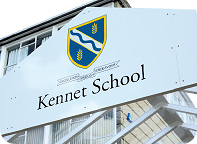 All of which goes some way to explaining why Kennet School is now the most oversubscribed school in West Berkshire, why the latest OFSTED report in March 2005 described it as “a very good school with many outstanding features” and why headmaster P.G.Dick was awarded the O.B.E for services to education in 2000.
Headmaster, Mr Dick, however, is not the only member of staff whose work in education has been publicly recognised. In 2003, Martyn Greenway was a Special Commendee – “The Award for Teacher of the Year in a Secondary School in South of England” – in the prestigious Teaching Awards scheme sponsored by the Guardian and DfES.
With more than twenty years teaching experience, Martyn heads up a music department comprised of three full time and one part time teacher, augmented by eleven peripatetics with another full time member employed as a technology specialist. Presently, there are 70 students taking GCSE music and 20 taking A level Music and Music Technology.
The department is housed in three classrooms, with an additional Music Technology room containing M-audio fast track interfaces, MIDI PC 160 Roland controllers and ten networked PCs loaded with Sibelius and Cubase software. The two larger classrooms accommodate the school’s electronic keyboards and an interactive white board. Students also have access to a 24 track recording studio, a dedicated Listening Room and a small number of practice rooms.
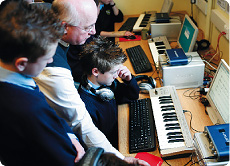 A typical classroom set-up might see a group of students working on keyboards, another group working on Sibelius or Cubase projects and a third group rehearsing singing techniques. Over a two or three week period these groups will be rotated so that all the students have the opportunity to develop their various skills.
Sibelius and Cubase are the primary software applications employed within the department and while there is a rough ‘division of labour’ among his younger charges, Martyn reports a great deal of crossover among older students. “Music Technology students favour Cubase but will score write in Sibelius. GCSE and A level Music students tend to stick with Sibelius; though not exclusively.”
Martyn has used Sibelius for the past five or six years, “we started with version 2. It’s become an industry standard but it’s a program that is obviously developed by musicians and is much more music based than technology based.”
Sibelius, he says, is an ideal tool, to develop musical ideas and concepts such as notation, tempo, dynamics and cues. “For example, if we’re following a Blues project that includes ‘Watermelon Man’, students might want to transpose the chords or melody to fit a transposing instrument. A number of skills that they’ve learned in year seven are replenished in year eight. Sibelius doesn’t just function as a teaching tool but as a tool to reinforce what has been learned earlier in the curriculum.”
Sibelius supports the curriculum in a variety of ways. Pre-prepared accompaniments are provided that encourage students to add melodic lines, additional parts and ornaments with additional menu pages included for revision purposes. Resources have been developed in conjunction with Microsoft Word that enable score annotation and the inclusion of teaching notes and Sibelius and Cubase are used in tandem with a large number of students sequencing with Cubase and having a score running concurrently in Sibelius. One encouraging outcome says Martyn, is that, “GCSE students are now more inclined to compose for specific ensembles and understand more clearly the instruments and ensembles for which they’re writing.” And with a number of thriving musical ensembles – Orchestra, Senior Choir, Stage Band, Wind Band, Gamelan Orchestra – the score writing features of Sibelius are always in demand.
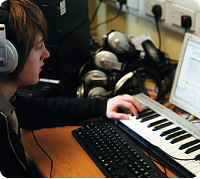 Used imaginatively, good technology can enhance communication between teacher and student. Martyn cites the use of e-mail. “Students will email in their work and the Sibelius file will go back and forth with various suggestions. For example, I might send a piece of music back with the comment, ‘you now need to think carefully about articulation and dynamics in each of the parts.’ I might be in touch with students two or three times a week outside normal lessons via email. I wouldn’t say that it’s a larger workload, but it’s definitely a smarter, more exciting and interesting workload since you can see a quicker rate of progression – the student developing real skills more quickly and effectively.” That sort of progression, says Martyn, can’t be generated by any other program. “That’s where Sibelius is unique.”
He also identifies the Playback function as a crucial educational tool. “Students’ experience is limited until they can actually hear the timbral qualities of individual instruments. That’s what really gives them ownership of what they are doing. If they’re writing, say, for a Wind Quintet, they can compose music more effectively for each specific instrument and instruments in combination, actually hearing what they’ve written rather than seeing it on a page. And the onboard sounds in Sibelius are good too.” Older students are encouraged to organise ‘live’ performances of their compositions.
Year 9 goes Parisian!
In Year 9, the students work on a project based on Paris at the turn of the 19th century. This includes Impressionism, the musical movement spearheaded by Claude Debussy. Having explored major, minor and pentatonic scales at an earlier stage in the curriculum, Impressionism is an ideal context in which to introduce whole tone/chromatic scales and related chords.
The more able Year 9s, says Martyn, are then encouraged to compose a piece of music for piano - “Reflections in the Water” - utilising these aspects. They are able to experiment with whole tone scales and chords using keyboards. “With Sibelius, Martyn explains, “students are then able to input their chords, easily manipulating the notes to modify or create different chords (a task that is significantly more difficult on keyboard) thus further developing the composition. Often students will compose a piece of music and. . . . that’s it! They won’t necessarily go back and refine it.” If, however, they have access to the composition on a PC, “they can listen to a sequence of whole tone chords that they have composed then add a response. That moves them on because they become much more critical and aware of what they are creating. It’s really exciting when students start to realise that they have ability and fly with it”
Ultimately, Martyn is keen to emphasise, the curriculum is delivered by the teaching staff. Sibelius, however, enhances that delivery by adding a “further dimension and enrichment and offering instant access to a real musical world while supporting the progress of developing musicians. It’s great”, he continues, “when you can see just how motivational good software can be. Students will often come back to the music rooms at break, lunchtime and after school to work on projects. “
You won’t find a better endorsement than that.
“It’s great when you
can see just how motivational good software can be.”
Martyn Greenway, Head of Music
Kennet Comprehensive
Other case studies

SibeliusEducation forums
Chat about teaching and learning in Music.