
Education Case Study
Sir John Lawes School
Head of Music Jon Walton reveals how he uses Sibelius to help motivate and inspire students at this mixed comprehensive for 1040 students.
Jon Walton began using Sibelius just after it became available for Windows. "I'd heard a lot about it from an Acorn user, but had no hands-on experience, so I said to myself that if kids were going to be able to use it effectively in the classroom then I should be able to write all the band parts for our school musical in two weeks. And I did! I was trying to look at it from the kids point of view as well, so I didn't read any handbooks or anything like that, and I still found it very easy to use.
"I first tried Sibelius in examination classes, and it really blossomed, so I progressed to the other year groups from there. The launch of Sibelius 2 then coincided with our bid for Media/Arts Specialist College status, and although the bidding process was pretty involved, we did get quite a lot of funding for the software that way. Now most, if not all, of our GCSE and A-level coursework is completed on Sibelius."
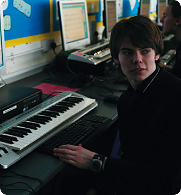 Working with a very wide range of abilities, Jon has found that Sibelius makes it very easy to differentiate between students during performing activities. "For example, if there's a problem with someone being unable to play a given part, you can quickly make it easier, or copy something across from one part to another. In a lot of cases, I've actually found myself making parts more difficult as well, to cater for an outstanding musician in the class. The plug-in which puts letter names under the notes also helps in some cases, where a few kids simply cannot read notation.
"Because different students in the class tend to be at different stages when I'm teaching Bach chorale harmony, I like to prepare several different work templates. For instance, there are some kids who really benefit from both the treble and the bass parts being present, so I just Filter the alto and tenor from the completed chorale and it only takes seconds."
Motivating and inspiring students in the classroom can be tough in any school, but Sibelius has helped Jon tackle this challenge in a variety of ways. "That pupils, even from a very early age, can produce scores that look professionally published is a motivational thing in itself. It's also enlightening for many students when I throw MIDI files into Sibelius so that they can see how the music that they love works, and how simple some music really is.
"The school is involved in the Musical Futures Project, a scheme for Year 9 where they learn aurally, getting into groups and imitating a song from CD. If they are really struggling, I can give them a MIDI file of the song and get them to take out the other parts in Sibelius, so that they can have a look at what the chords are doing.
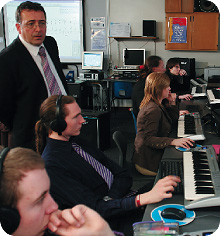 "We also take part in an interschool music festival where all the secondary schools arrange a piece for the junior schools to sing. For the past few years we've been able to give that to some Year 10 students who then just go away and do their own arrangement. This is a motivational thing as well, because they're producing material for their own groups to play.
"In terms of composition, we've certainly noticed an impact on exam performance from using Sibelius. We've had several pupils who have been able to create full orchestral film scores, and have done it very, very well. It's something that they wouldn't have been able to do without this level of notation software."
As someone using Sibelius extensively in the school environment, Jon is keen to encourage other teachers to take the plunge. "Choose something that you want to do, perhaps a personal project, and then just do it - get your feet wet! Everything I've wanted to do in Sibelius, I've been able to do. Then think of how what you've learnt can be applied in the classroom. Start small - pick a single class perhaps, and maybe begin with some activity that they've already been doing, and are already comfortable with."
Introduced in Sibelius 4 was the powerful new Worksheet Creator, complete with a built-in library of 1700 teaching and learning resources ranging from project sheets to posters and flashcards. Jon and his department have already discovered what a great help this material can be for classroom work. "It's something that we've used a lot at all levels, from Year 8 chord progressions to Bach chorales in the Sixth Form. It's great having the templates because the layout is already there - indents, breaks, and so forth. It's good to work backwards from the templates as well, so you see what's been done and apply it to your own specific situation."
About the teacher and school
Jon Walton knew that he wanted to be a teacher from the age of 11, starting as an NQT at Sir John Lawes School in Hertfordshire, a mixed comprehensive school with 1040 students between the ages of 11 and 19. He quickly went on to become Head of Music and the school is now a designated Media/Arts Specialist College, housing a TV studio and well-developed music technology facilities. Music is taught at GCSE and A-level, with an average of 12 students entered for AS/A2 exams every year. Around 400 individual instrumental lessons take place every week, alongside a range of other extra-curricular music activities, including brass, woodwind, and string ensembles; guitar and electric guitar groups; an orchestra; a soul group; a big band; and musical theatre productions such as Oliver and The Wizard Of Oz.
“ We’ve certainly
noticed an impact
on exam performance”
“ Just do it, get your
feet wet! Everything
I’ve wanted to do in
Sibelius, I’ve been
able to do.”
Jon Walton, Head of Music
at Sir John Lawes
Other case studies

SibeliusEducation forums
Chat about teaching and learning in Music.